Millefiori Trade Beads

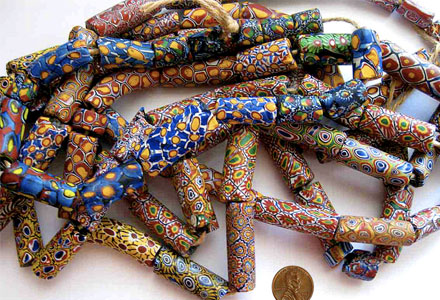
Millefiori beads have been treasured by the African people from far before the colonial period. Millefiori, literally meaninga thousand flowers’, beads are also known as Mosaic trade beads from ancient time throughout the world. Millefiori trade beads are one of some African trade beads that were used as currency to trade and exchange for goods in Africa during the colonial period. As the meaning implies millefiori beads come in different color variations and beautiful designs. Because of the fact that Millefiori trade beads are handcrafted you’ll find the nuance difference between them. There are no two beads alike and each bead is a work of art. They are characterized by their long shape which is longer than other African beads.

Originally, the millefiori beads were made dominantly in Venice in the late 1800’s and imported to Africa for trading purpose. They were produced by creating flowers or stripes from glass canes, cut and molded onto a core of solid material and finally made into beads.

In the late 1960s, once more Millefiori beads became popular as jewelry in the United States. They were given the name ‘love beads’ by the hippies and made into necklaces as peace a symbol. A single piece of bead can make an exquisite centerpiece in pendants, bracelets, earrings, finger rings and many others jewelries. People also buy them as collector items because of their colorful history. They are rising in value by 10% each year. Because of their exquisite beauty they are precious as gifts and decorative items.

Some other popular beads such as Kiffa beads of Mauritania were evolved based on the great demand of Millefiori beads. Though they were evolved to mimic the appearance of Millefiori beads, the fascinating attraction to Millefiori beads is still deep rooted. Today, old millefiori trade beads are very expensive, especially if they were made in Venice in the 1800s or used in the 1960s and 1970s.

Fulani African Trade Beads and Funeral Beads

Fulani Funeral Beads

Fulani trade beads are a particular type of glass beads probably made in Bohemia (which is modern day Slovakia and the Czech Republic) in the late 1800s or early 1900s and were traded to the Fulani Tribe in Africa. The Fulani were one of the dominating cultures of all of West Africa but colonization put an end to their empire, resulting in the scattered nature of the Fulani today. They value colorful beaded jewelry and body ornamentation above most African peoples. Since they are nomadic, the Fulani produce a very limited range of art objects and purchase or trade for materials for subsequent use. Fulani trade beads are one of a few trade beads that have survived a hundred or more years of wear and the travel through at least three continents.

Now Fulani trade beads are more popular and collectable than ever. They have played an important role throughout the Fulani tribe. Different types of Fulani beads are now in private collections around the world. The African Traders are having to go deeper and deeper into Africa to find more of these beads and many styles which were readily available just 5 years ago are no longer seen today.

The size and shape of Fulani trade beads varies from tube to spherical shaped. Fulani people used these beads as necklace, pendants, earring, bracelets, waist-belt, and other body ornaments. Genuine old Fulani trade beads can still be found in this day and age with luck.

Prosser Trade Beads

Prosser beads are African trade beads named after the Prosser brothers. The brothers invented a button making machine in the 1830′s, and started to make beads around 1840. By the 1860′s all beads were being made in England using that button-making machine and traded in Africa. The process consists of molding a dry porcelain powder under great pressure and then firing it. The finished product was then called porcelain beads. This method allowed for making beads only one at a time. Prosser Beads were opaque, and not translucent.

Two types of prossers beads have been found so far, one is spherical and the other one is short and cylindrical. However, all Prosser beads have a thin seam around the equator. One end is rounded and smooth, while the other is flat and rough or pebbled. The perforation tapers toward the rounded end.

After 1860, Prosser beads are said to have been made in France. Jean-Félix Bapterosses used to make similar glass beads with a completely different machine. After the 1870, European war Czechs produced Prosser Beads for some time. Prosser beads have also been produced in Germany and Italy as well.

The beads were introduced into the Western United States and often used as wampum for trade with the American Indians, who then incorporated the beads into their crafts. Today, African traders call Prosser beads kankanmba beads, or kancamba beads.

From Germany to Mali: Dogon Donut Beads

Dogon beads

Strand of mixed African Dogon beads

Dogon Beads originate from Holland in the 1800′s. Other sources cite that the beads were also crafted in Germany in the second half of the century. They were originally used in formal gardens to create mosaics as opposed to flowers. It wasn’t until they reached West African shores that they became popular with the Dogon people of Mali who, enticed by their beauty, used them as jewellery.

The physical make up of the beads themselves is quite unique and is the reason they were such popular trade beads in Africa. The hole in the beads is unusually large and so the beads themselves are sometimes called ‘Dogon Donuts‘ because of their shape. They are commonly light cobalt blue in colour but this can vary from light brown, red, white or green. Sizes of the beads vary but are commonly 13mm in diameter and 3mm thick.

The price of the beads can range between $35 to $350. This depends how many beads there are in the set and what condition they are in. More beads doesn’t always mean a higher price however, as certain designs or colours are more rare than others but a realistic price to pay for beads created in the late part of the 18th century is about $290. This is for buying them online though, and the cost may be higher if purchased through a specialist retailer or at an auction. If you aren’t interested in getting antique beads, you can get a nice set for about $35 that still looks good.

Information is difficult to find on the beads but their rarity and beauty make them a valuable collectors item. Please leave a comment below to add your own stories about any sets you might own or where you can find them.

Ghana Recycled Powder Glass Beads

Ghana recycled glass beads

Blue-Brown Swirl Recycled Glass Beads from Ghana - Courtesy of TheBeadChest.com

Powder glass beads are not typically considered African trade beads, even though some may call them that, but I have a great fascination with them so I figured I would write a bit about them.

Ghana is known to be home to some of the greatest bead markets in Africa. Koforidua, Agomanya, and Cedi Bead Factory are just a few of the popular destinations for beading tourists. At these markets, you will find extravagant selections of Ghana powdered glass beads. The most popular kinds are recycled glass beads, Krobo beads, and sandcast beads.

Growing up as a total hippie, and raised to be green-friendly and environmentally conscious, obviously my favorite are the recycled glass beads. The reason they are so fun is because they are made using crushed recycled bottles. The bead maker will collect used bottles from local restaurants and bars, such as Coca Cola, Sprite, and Beer bottles. They bring them back to their workplace, and proceed by crushing the glass. Next, they melt the crushed glass and place the molten material into clay molds. They use the stem of a leaf to create space for the hole, and continue by baking the beads for several hours.

These beads come in at least 50-100 colors, and each color is made using either different types of bottles, or sometimes with some sort of natural coloring. There are solid colors, like green, blue, and occasionally rose, but there are also often mixed colors. For example, my favorite is a swirl of green, brown, and clear.

These beads typically run for about $15 per strand for the standard 10mm-12mm size. Occasionally, you can find the extra large size, in which the beads are about 30mm in diameter, but these are harder to come by…and far more expensive. They can run anywhere up to $50 per strand.

On my next post, I will gather some cool creations I’ve spotted on Etsy, using these awesome Ghana recycled glass beads.

African Kiffa Trade Beads are Hard to Find

African Kiffa Beads

Photo belongs to UniqueAfricanArts.com

Created in the town of Kiffa located in Mauritanian Sahara Africa, these beads are a rare and beautiful example of the skilled artwork from the women who live there. Having being produced from over 100 years ago, these African trade beads used to be far more popular than they are today. They would be traded all over the continent in sackfuls but in the early 2000′s, they declined in popularity. Today, they are difficult to find and although the quality has somewhat dropped over the years, they are still sought after by many.

Kiffa beads are created by taking clear glass, and grinding it into smaller pieces on a concave stone. This is done until they are in a fine powder. After this, a small amount of diluted gum is added to the glass and a spherical core is shaped. Then a hole is pierced through the centre using a small wooden stick. After which, some more of the gum is added with a little coloured powder and mixed. This is applied to the sphere along with other colour for decoration. This is a continuous process in which, in the hands of a skilled craftswoman, does not result in any smudged colours or decoration.

The bead is left to dry for eight hours after which it is fired. This is done by placing it in a dish with sand and covering it with a metal bowel. This arrangement is then covered in charcoal and it’s taken outside and set alight, completely surrounding it with flames for two hours.

Because of their rarity, these beads can be expensive. Buying a set will often cost about $150. Older beads, which are even more difficult to find and of higher quality, can cost up to $400. The price depends on the decoration and how many beads in total there are in the set.

But while the price of the beads may be quite high, they are an excellent example of a tribes culture and a rare artistic skill that isn’t found anywhere else. Why do you like Kiffa beads? Leave a comment and share :)

African Don Don Sole Beads from Mali

Don Don Sole Beads

Image courtesy of TheBeadChest.com

Don Don Sole beads, also known as Mali Wedding beads, are vintage African trade beads from Mali. These handmade beads were produced in Europe in the early 20th century, and quickly made their way into the African trade.

Don Don Sole beads are also known to some as Mali wedding beads because they are given to brides in Mali on their wedding day. They are some of the most colorful and joyful glass beads from Africa. The glass beads come in over 20 different colors, and are shaped like light bulbs. Their design is one most often found in Czechloslovakia, but today these beads are often replicated in India and China. Authentic African Don Don Sole beads are strung on a kind of twisted cotton, and they spin around, or rotate around the thread.

These beads can run anywhere up to a few dollars a bead, especially for rare colors that are less common. Because of their old age, a strand usually runs anywhere from $70 to $120, depending on the size in shape. The most common shapes and sizes are large rounded bulbs, small rounded bulbs, flattened tear drops, and triangles. The triangle shape and small rounded bulb shape are the hardest to come by.

Old French Cross beads from the African trade

French Cross Beads

French cross beads are Venetian-made glass trade beads that come from Africa. Venice bead makers began making these beautiful beads in the late 19th century, and Africans quickly began using them for trade. Beginning in the 20th century, bead enthusiasts and traders began exporting them from Africa, to the United States, England, and Europe.

There are two types of French cross beads: yellow and white. The yellow trade beads are often more accessible, while the white are a bit more rare and hard to find. The beads measure anywhere from 5mm – 7mm in width, and 10mm – 12mm in length. These beautiful glass beads are usually sold by the strand. Prices fluctuate, as the supply is not steady. A strand can run anywhere from $35 USD to $150 USD depending on the age and quality. Obviously older strands tend to be on the more expensive side. They are often also a bit worn out, but this is something true trade bead collectors cherish.

From our experience, French cross beads are not always easy to come by. If you your local african bead supplier has them in stock at a reasonable price, and you want a strand, we urge you to purchase it. Many analysts predict that these beads may be sold out in the near future. Production may continue, but you will not be able to find an old strand of these trade beads, with a rich history as easily.

AfricanTradeBead.com – A Website for African Trade Bead Collectors

Welcome to AfricanTradeBead.com, a new website for collectors, by collectors, totally devoted to the topic of African trade beads.